The best e-commerce order management systems for scaling brands in 2026
A practical comparison of five e-commerce order management systems for brands planning to grow in 2026. We cover Billbee, Xentral, Shopware OMS, Shopify's native system and SendNet, with verified pricing, a feature overview and a clear decision framework.

Key takeaways
- An e-commerce order management system (OMS) receives, routes, tracks and processes orders across multiple channels while keeping inventory accurate in real time. The right system eliminates manual work rather than merely automating it.
- The four criteria that matter most are integration depth, multi-channel support, scalability and automation. A system that scores well on all four rarely forces you to switch platforms as you grow.
- According to SendNet's fulfillment data, connecting order management directly to warehouse management produces a 99.6% pick and pack accuracy rate and 99.9% delivery reliability.
- Billbee starts at €9 per month and suits smaller multichannel brands. Xentral (from €349 per month) is better suited to small and medium-sized businesses that need ERP functionality within the same platform.
- Shopify's native order management works well early on. Most brands outgrow it quickly, though, once order processing complexity, B2B workflows and warehouse operations grow beyond a single location.
Now that brands sell through ever more channels, the best order management system is the one that keeps inventory, orders and fulfillment aligned without adding manual work. That sounds obvious. In practice, most order management systems (OMS) handle the software side well but leave actual execution to someone else — and that's precisely where errors and delays pile up.
This guide covers the five leading OMS options for scaling e-commerce businesses in 2026, what each is designed for and how to choose based on the stage your business is at right now. For a broader view of how order management connects to fulfillment execution, the SendNet e-commerce guide a complete picture.
How do you choose an e-commerce order management system (OMS)?
Four criteria separate a good OMS from a system that will only slow you down as you scale.
Integration depth matters more than a list of features. Shallow syncing leads to fragile workflows and duplicate data entry. Deeper integration keeps orders, inventory and fulfillment status flowing smoothly through one central system, so nobody has to reconcile spreadsheets at the end of the day.
Multi-channel support becomes essential as soon as your brand sells simultaneously through Shopify, third-party marketplaces and B2B or retail channels. An OMS designed for a single store will quickly show its limits.
Scalability means the platform can handle rising order volumes, more warehouses and new channels without forcing you into an expensive migration at the worst possible moment in your growth. Read more about what that looks like in practice in SendNet's guide to scaling e-commerce fulfillment.
Automation is as much about exceptions as it is about routine operations. A good OMS should handle order splitting, product bundles, stock rebalancing and routing rules without any manual intervention. If your team regularly has to resolve exception cases by hand, that's a routing logic problem, not a volume problem.
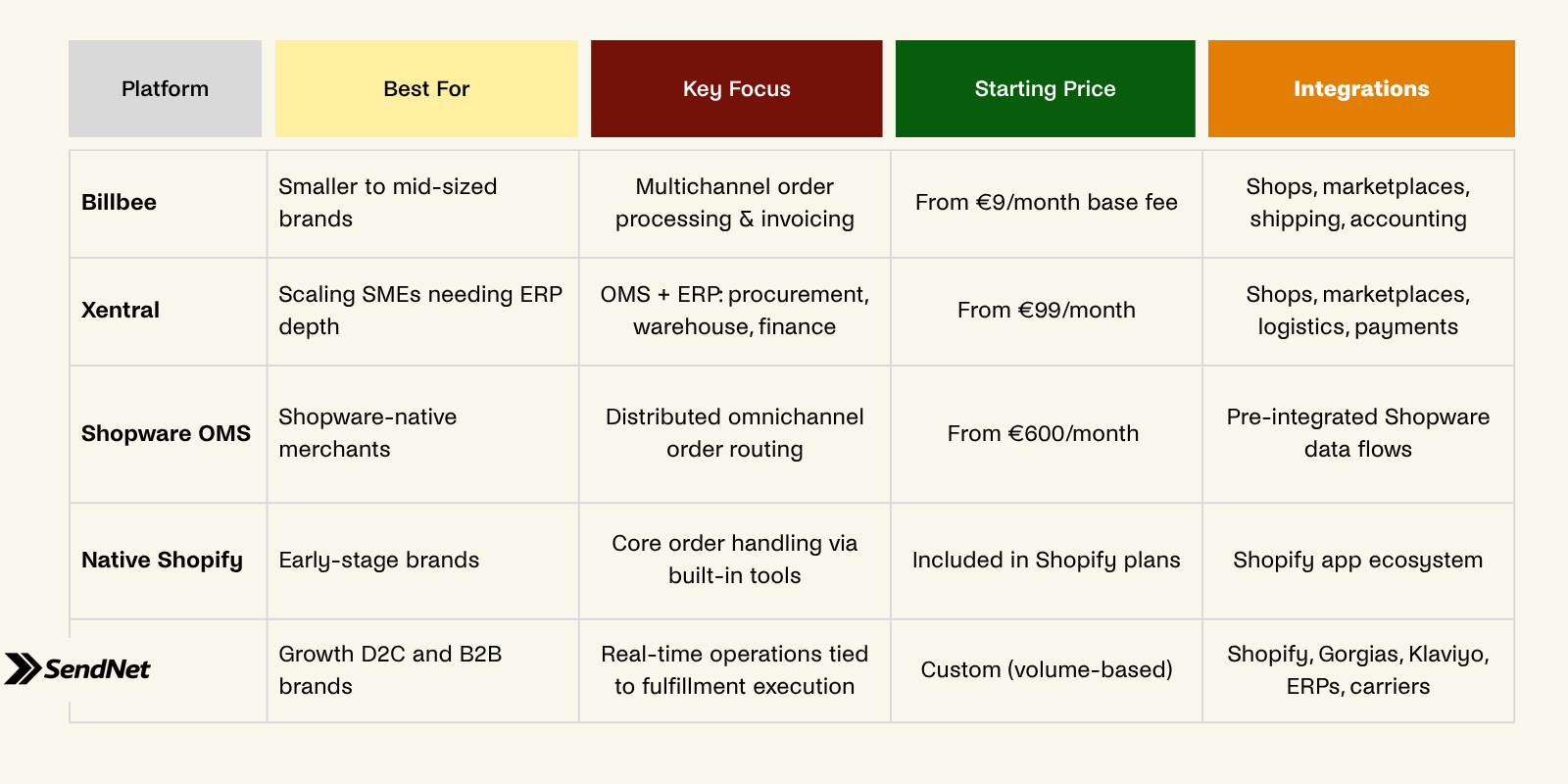
Platformprofielen: Billbee, Xentral, Shopware OMS, Native Shopify en SendNet
Billbee: the best choice for multichannel order processing at smaller volumes
Billbee is a practical, highly accessible multichannel system. It comes into its own for brands that need centralised order processing and invoicing rather than advanced warehouse coordination. Setup costs are low and the model transparent, which matters when you're watching operational costs carefully.
Key features:
- Multichannel order and invoicing workflows, all in one dashboard.
- A billing model where you pay per order, with no minimum term.
- Automatic invoice creation and customisable email rules.
- Unlimited users and store integrations are included on every plan.
Pricing: Billbee's model starts at €9 per month for the Starter plan (up to 200 orders per month), with pricing rising logarithmically from there with order volume. There's no minimum contract term, every plan lets you add unlimited users, and the 30-day free trial doesn't require payment details.
Xentral: the best OMS and ERP combination for scaling SMEs
Xentral is far more a full ERP system than a pure OMS. That makes it useful for scaling brands that want to bring order management, procurement, warehouse operations and financial reporting together in one environment, rather than stitching it all together across separate tools.
Key features:
- A cloud ERP architecture combining CRM, procurement and warehouse management.
- More than 200 verified integrations via API and Xentral.
- Batch and lot number tracking and expiry dates, important for food and cosmetics brands.
- Automated reordering logic based on dynamic minimum stock levels.
Pricing: According to Xentral's official pricing page there are five plan tiers. The 'Launch' plan costs €99 per month (capped at 1,200 orders per month and €500,000 annual GMV). The 'Starter', 'Business' and 'Pro' plans cost €349, €649 and €849 per month respectively when billed annually. There's also a fifth tier, 'Scale', for high-volume businesses at custom pricing. All paid plans include unlimited users. Xentral's marketplace of more than 200 connectors is available from the Business plan onwards.
Shopware Distributed OMS: the best choice for merchants in the Shopware ecosystem
Shopware OMS is the right choice if your e-commerce setup is built entirely on Shopware and you need to route orders through a distributed network of fulfillment locations, including stores acting as local fulfillment points alongside central warehouses.
Key features:
- Data flows directly into the Shopware ecosystem.
- Available-stock calculations that reflect actual inventory across every location.
- AI-driven route planning that optimises delivery routes in real time.
- Store operations apps that guide picking and packing.
Pricing: Shopware offers four plan tiers, according to their official pricing page. The Community Edition is free and open source (MIT licence) for stores with GMV under €1 million. Rise starts at €600 per month, Evolve at €2,400 per month and Beyond at €6,500+ per month. The paid plans scale with your gross merchandise value. The higher tiers include distributed OMS capabilities and advanced order routing features.
Shopify's native order management: the best starting point for early-stage brands
Shopify's native order management is a solid starting point. Basic order fulfillment functionality is built into the Shopify dashboard, there's an extensive app ecosystem and setup time is minimal. For a single-channel brand with manageable volume, this is enough.
You hit a ceiling fairly quickly. As soon as a brand needs deeper shipping rules, complex warehouse logic, multi-warehouse coordination or structured B2B operations, Shopify's native tools reach their limits. For most scaling brands, Shopify stays the front end while a dedicated operations layer handles the complexity behind the scenes. In SendNet's Shopify fulfillment comparison shows what that handoff typically looks like.
Pricing: Included in the standard subscription.
SendNet: the best OMS connected to warehouse management and fulfillment
SendNet's order and inventory management isn't set up as a standalone management layer. It acts as the connective brain of a broader operations platform, taking you straight from order visibility through to warehouse fulfillment, carrier delivery and returns, without switching manually between separate providers.
Volgens SendNet's fulfillment data this integrated approach produces a 99.6% pick and pack accuracy rate and 99% delivery punctuality across more than 100 million items shipped. When order data and warehouse data live in the same system, fewer manual corrections are needed and fulfillment teams work considerably faster.
Key features:
- Real-time order and inventory management synced across D2C and B2B channels.
- Customisable workflows for order holds, bundles, kitting and batch management.
- Live restock alerts to prevent stockouts and overselling.
- Close integrations with Shopify, Gorgias, Klaviyo and the major carriers.
- Retourbeheer is in hetzelfde platform geïntegreerd. Read more about setting up an effective returns strategy.
Pricing: SendNet works with a commercial model that scales with shipping volume. Order management is part of the broader operations platform. See SendNet's fulfillment page for more information.
Why an integrated approach matters
Order management and physical fulfillment performance are closely linked. When orders route correctly and inventory data is accurate in real time, warehouse staff spend less time resolving discrepancies and more time getting the work done.
A standalone OMS hands data off to a separate warehouse management system, a separate carrier layer and often a separate returns tool as well. Every interface is a point where data can go astray. An integrated platform removes those handoffs. To understand how a WMS fits in, the difference is explained in detail in SendNet's guide to the meaning and benefits of a WMS.
Selectiekader
Choose Billbee if you're looking for an affordable way to process orders and generate invoices across multiple channels, with a simple, usage-based pricing structure.
Choose Xentral if you need a broader ERP system covering warehouse management and procurement in the same environment as your OMS.
Choose Shopware OMS if your e-commerce setup is built on Shopware and you want to distribute orders across multiple fulfillment locations, including stores.
Choose Shopify's native order management if you're still at an early stage and the native workflow still meets your operational needs.
Choose SendNet if you want to integrate order management into a larger operations engine that handles fulfillment, delivery and returns as one coherent system.
The bottom line
The OMS market in 2026 is clearly divided by operational stage. Billbee suits brands looking for simplicity and low overhead. Xentral suits anyone who needs deep ERP functionality. Shopware OMS fits merchants already inside that ecosystem. The native Shopify solution works — until it doesn't.
The key question for most scaling brands is whether they want a standalone OMS or an operations platform that links order management to actual execution. Standalone systems require more integration work and create more points of failure. An integrated approach closes those gaps by design.
If you're at a stage where fulfillment errors cost money and manual corrections eat up a lot of your team's time, that's the clearest sign you've outgrown a standalone OMS.
Frequently asked questions
What is an e-commerce order management system?
An e-commerce OMS is software that receives, routes, tracks and processes orders across multiple sales channels while keeping inventory accurate. It sits between your sales channels and your fulfillment operations, ensuring every order reaches the right place in the right state.
What features matter most in an OMS?
Integration depth, multi-channel support, scalability and automation are the four most critical capabilities. An OMS that handles all four of these without forcing manual workarounds is the one worth investing in.
Is Shopify order management enough for scaling brands?
It works well early on, but most scaling brands outgrow it. For more advanced routing logic, multi-warehouse coordination, B2B workflows and exception handling, you need a purpose-built operations layer that goes beyond what Shopify provides natively.
What is the difference between an OMS and an ERP?
An OMS focuses on orders, inventory and fulfillment workflows. An ERP covers a broader range of business functions, including procurement, HR and finance. If you want to know exactly how a WMS and an OMS work together, you can read up on the difference in SendNet's guide.
How does order management affect fulfillment speed?
Better order data means fewer manual exceptions, improves stock accuracy and lets warehouse teams pick, pack and dispatch without stopping to resolve data errors. The operational impact is measurable, not theoretical.
What is Billbee best for?
Billbee is ideal for brands looking for a reliable multichannel order and invoicing tool with a transparent, usage-based model and no minimum contract.
What is Xentral best for?
Xentral is best for scaling SMEs that want order management as part of a wider ERP system that also handles warehouse operations, procurement and financial reporting.
How is SendNet different from a standalone OMS?
SendNet connects software-based order and inventory management directly to physical fulfillment, multi-carrier delivery, tracking and returns. According to SendNet's fulfillment data, this integration produces a 99.6% pick and pack accuracy rate and 99% delivery punctuality across more than 100 million items shipped.